

Introduction: Designing for Climate Is Not Optional in Bangladesh
Bangladesh presents a complex climate profile:
- High temperature and humidity
- Intense solar radiation
- Heavy monsoon rainfall
- Occasional flooding
A house that ignores these realities will overheat, retain moisture, and degrade faster.
The objective is simple:Reduce heat gain, remove heat quickly, and protect against water.
Understand the Local Climate First
Key Climate Forces:
- Sun: Strong east-west exposure
- Wind: Seasonal variation (south/southwest dominant in summer)
- Rain: Heavy, wind-driven monsoon
Design must respond to all three simultaneously—not individually.
Optimize Building Orientation (First Decision, Highest Impact)
Best Practice:
- Align longer axis along East–West
- Maximize openings on North and South
Why:
- East/West sun is low-angle and intense
- North light is soft and consistent
- South can be controlled with shading
Constraint Reality:
Urban plots often restrict orientation. In that case:
- Use buffer zones (stairs, toilets) on west side
- Increase shading and insulation
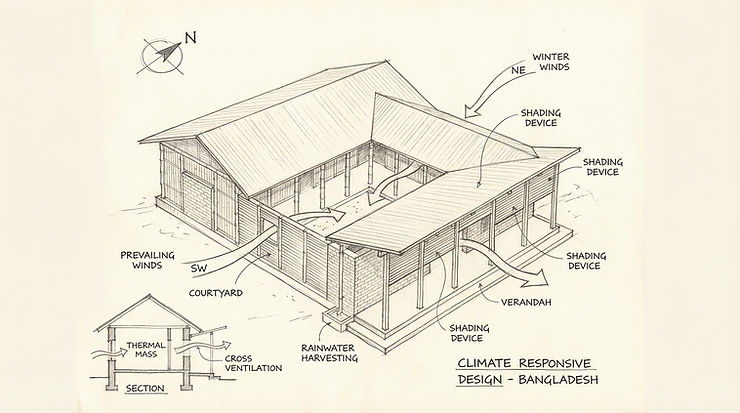
Design for Cross Ventilation (Primary Cooling Strategy)
In humid climates, ventilation is more important than insulation.
Core Rules:
- Openings on opposite walls
- Align with prevailing wind direction
- Avoid deep, sealed floor plans
Advanced Layer:
- Use stack ventilation with high vents or voids
- Introduce courtyards or lightwells

Control Solar Heat Gain with Shading
Effective Shading Elements:
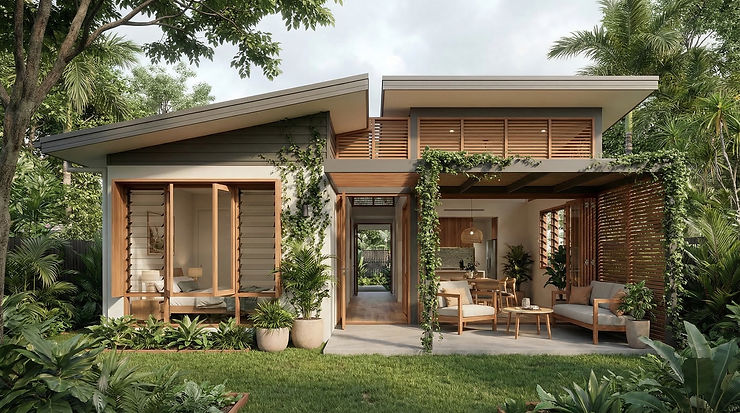
- Deep roof overhangs
- Verandahs (highly effective in Bangladesh context)
- Vertical fins for west facades
- Perforated screens
Critical Insight:
Shading must be external. Internal curtains do not stop heat gain effectively.
Roof Design: The Most Critical Thermal Surface
Strategies:
- Use light-colored or reflective roofing
- Add insulation or air gap
- Consider double roof systems
Monsoon Response:
- Ensure proper drainage
- Use sloped roofs where possible
- Protect edges and junctions
Material Selection for Tropical Performance
Recommended Materials:
- Brick with thermal mass
- Perforated brick (jaali) for airflow
- Bamboo or local materials for shading layers
Avoid:
- Excessive glass facades
- Dark heat-absorbing finishes
Plan for Monsoon and Water Management
Ignoring water is a major failure point.
Design Measures:
- Raise plinth level
- Provide proper site drainage
- Design wide roof overhangs
- Integrate rainwater harvesting
Spatial Planning for Thermal Comfort
Smart Zoning:
- North: bedrooms and living spaces
- South: active zones
- West: buffer spaces (stairs, toilets, storage)
- East: kitchen
Why:
This reduces heat exposure in frequently used spaces.
Landscape as a Climate Modifier
Strategies:
- Trees on west side to block sun
- Vegetation to cool incoming air
- Courtyard planting for microclimate

Common Mistakes in Bangladesh Context
- West-facing large windows without shading
- Flat concrete roofs without insulation
- Poor drainage leading to water damage
- Ignoring ventilation due to privacy concerns
Advanced Strategies for High-Performance Homes
- Double-skin facades for heat reduction
- Thermal chimneys for enhanced airflow
- Hybrid systems combining passive + minimal mechanical cooling
These differentiate average houses from high-performance architecture.
Conclusion
A climate-responsive house in Bangladesh must integrate:
- Orientation
- Ventilation
- Shading
- Material performance
- Water management
When these work together, the result is a house that stays cooler, lasts longer, and consumes less energy. Whether you’re planning a new home or optimizing an existing design, Graphite can help you reduce costs, improve performance, and make smarter architectural decisions from the start.
Reach out to Graphite to explore how your project can be designed better, built smarter, and perform efficiently over time.Fill out the form here